
Our Country
Pakistan is the world’s 5th most populous country, with an estimated 2026 population of about 259 million people.
Pakistan covers about 882,000 square kilometers and has a coastline of approximately 1,046 kilometers along the Arabian Sea. Its northern mountain ranges include K2, and several of the world’s highest peaks are located in Pakistan-administered mountain regions.
English remains widely used in government, higher education, business, media, and professional communication across Pakistan, alongside Urdu and many regional languages.
Pakistan maintains one of the larger military forces in the world. In 2026, open-source estimates place Pakistan around the top 15 globally for overall military strength, with roughly 650,000 active personnel and a nuclear arsenal commonly estimated at about 165–170 warheads.
Pakistan has a diverse media and cultural landscape. Urdu is the national language, English is widely used in official and professional settings, and more than 20 languages and many regional dialects are spoken across the country.
Pakistan continues to expand higher education, skills development, and technology training. The Higher Education Commission recognizes a large network of public and private higher education institutions, and the country produces a growing number of graduates in business, engineering, medicine, social sciences, and information technology each year.
Pakistan’s economy has shown signs of stabilization and recovery. According to 2026 reporting on the Pakistan Economic Survey 2025–26, real GDP growth reached about 3.7%, nominal GDP rose to approximately US$452.1 billion, and per capita income increased to around US$1,901.
Pakistan remains a developing economy with major opportunities in agriculture, textiles, services, remittances, information technology, e-commerce, logistics, and regional connectivity. Key challenges include poverty, fiscal pressure, energy costs, climate-related shocks, export competitiveness, and the need for broader tax reform and productivity growth.
Here are some useful links for detailed information
Pakistan Economic Survey 2024-25
IMF Pakistan country page
World Bank Pakistan population data
Pakistan Economic Survey 2025-26 news summary

Pakistan Pharmaceutical Industry
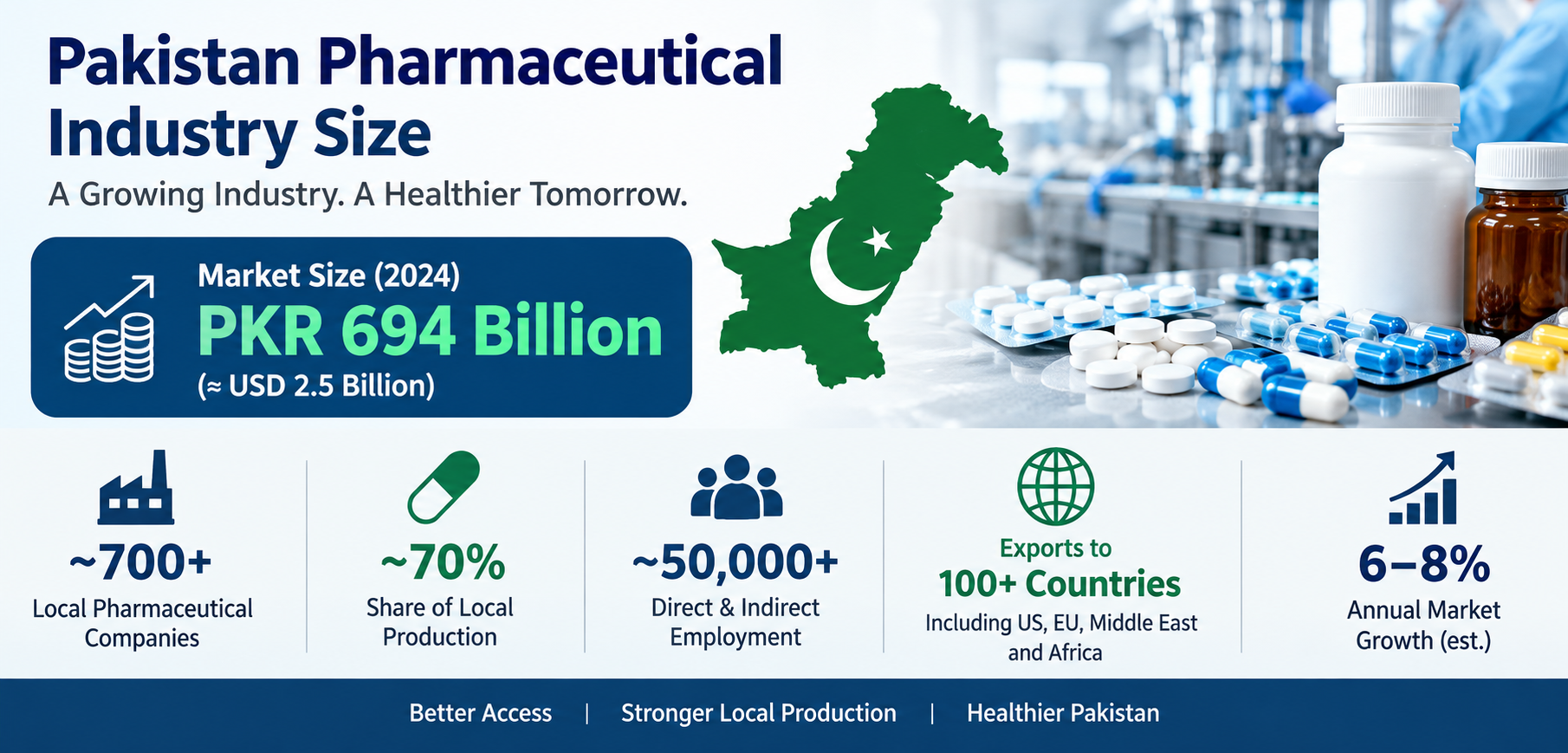
Pakistan’s pharmaceutical market is now estimated at about US$3.5 billion to US$3.8 billion, with industry revenue reported above PKR 1 trillion in recent 2025–2026 reporting.
Pakistan has more than 700 licensed pharmaceutical manufacturers and GMP-certified facilities. Local companies now supply an estimated 90% to 95% of domestic pharmaceutical demand, while multinational companies continue to operate in selected branded, specialty, and innovative medicine segments.
The industry has continued to modernize through investment in Good Manufacturing Practices, regulatory compliance, product diversification, vaccines, biotechnology-based products, oncology therapies, and value-added generic medicines. Recent reforms, including partial deregulation of non-essential medicine prices, have helped restore commercial viability and encouraged renewed investment in manufacturing capacity and exports.
Exports have grown strongly. Pakistan’s pharmaceutical exports reached about US$457 million in FY 2024–25, a record high and roughly 34% higher year over year. Key export destinations include Afghanistan, Sri Lanka, the Philippines, Uzbekistan, Iraq, France, Cambodia, Kenya, Myanmar, and Viet Nam, with exports reaching more than 80 countries.
Regulation is led by the Drug Regulatory Authority of Pakistan, which oversees registration, quality, safety, efficacy, therapeutic-goods evaluation, recalls, and pharmaceutical product databases. DRAP has also advanced digitization, serialization, and online regulatory services to improve transparency and reduce approval delays.
Despite growth, the sector still faces challenges including dependence on imported active pharmaceutical ingredients, affordability pressures, uneven medicine access, regulatory-compliance costs, and the need to expand research, development, and export-grade manufacturing.
Copyright © 2024 all rights reserved